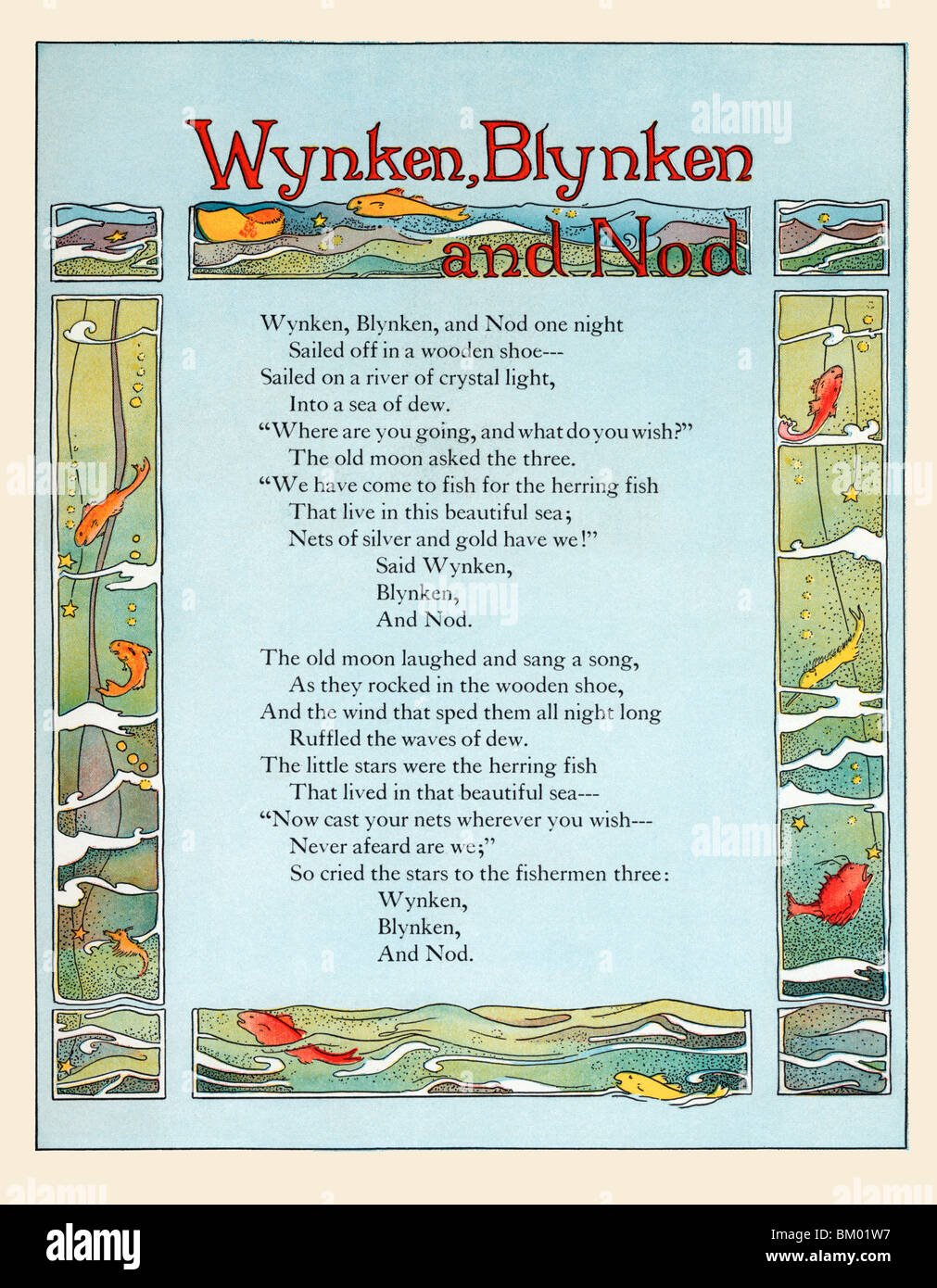
Amidst the vast treasury of children's literature, few pieces hold the gentle sway and timeless appeal of "Wynken, Blynken, and Nod." This enchanting poem, a classic lullaby that has soothed countless children to sleep, owes its enduring magic to the prolific pen of American writer and poet Eugene Field. Originally published on March 9, 1889, under the title "Dutch Lullaby," its narrative of three ethereal fishermen sailing among the stars in a wooden shoe captures the very essence of childhood wonder and the serene journey into dreams.
At a Glance: The Enduring Charm of Wynken, Blynken, and Nod
- Author: Eugene Field, a celebrated American writer and poet.
- Original Publication: March 9, 1889.
- Original Title: "Dutch Lullaby."
- Core Theme: A fantasy bedtime story about three children, sailing among the stars in a wooden shoe, revealed to be a child's eyes, head, and trundle-bed.
- Distinctive Features: Whimsical language, repetitive structure, and a subtle hint of Dutch influence in names and imagery.
- Lasting Legacy: Widely adapted into songs, animated cartoons, sculptures, and referenced in popular culture, cementing its place as a quintessential children's classic.
Eugene Field's Gentle Hand: Crafting a Dreamscape
Eugene Field was no stranger to the delicate art of captivating young imaginations. Known fondly as the "Poet of Childhood," his body of work often delved into themes of innocence, dreams, and the fantastical. When he first unveiled what we now know as Wynken, Blynken, and Nod in 1889, it was an instant classic, resonating with parents and children alike. His ability to weave simple language into profound imagery set him apart, making his poems not just narratives, but immersive experiences.
Field's creative process often involved observing his own children, drawing inspiration from their innocent perspectives and the imaginative worlds they conjured. This direct connection to the heart of childhood gave his writing an authentic, tender quality that continues to charm readers over a century later. He understood that a good lullaby wasn't just about rhyming words; it was about creating a safe, imaginative space for a child to drift off to sleep. For more on the man behind the magic, consider exploring Eugene Field's biography.
The "Dutch Lullaby" Unveiled: Decoding the Whimsy
The poem introduces us to three figures: Wynken, Blynken, and Nod, who venture out at night in a wooden shoe to fish for stars. This vivid imagery is enchanting on its own, but Field’s true genius lies in the poem's gentle reveal. The names themselves offer a clue: "Wynken" and "Blynken" evoke the slow, rhythmic blinking of sleepy eyes, while "Nod" clearly suggests a head nodding off to slumber.
The "wooden shoe" as a vessel is particularly interesting, aligning with the poem's original title, "Dutch Lullaby." This detail, along with the somewhat Dutch-sounding names, grounds the fantasy in a subtle cultural reference, perhaps reminiscent of folk tales passed down through generations. But it's in the final lines that Field pulls back the curtain:
- "Wynken and Blynken are two little eyes,
- And Nod is a little head,
- And the wooden shoe that sailed the skies
- Is a wee one’s trundle-bed."
This revelation transforms a fantastical voyage into an intimate, personal journey into sleep, encouraging children to close their eyes and embrace the wonderful dreams that await. Each of the poem's stanzas, consisting of 12 lines, masterfully uses repetition in the last three lines, creating a soothing, hypnotic rhythm ideal for reading aloud as children prepare for sleep. This rhythmic quality is key to the enduring appeal of lullabies.
From Page to Playlist: The Poem's Musical Journey
While Field’s poem was a lyrical marvel on its own, its journey into the musical realm cemented its status as a timeless classic. Just a year after its publication, in 1890, Ethelbert Woodbridge Nevin, an accomplished American composer, set "Wynken, Blynken, and Nod" to music. Nevin’s composition perfectly captured the poem's whimsical spirit and gentle rhythm, making it an instant favorite for bedtime singing. This transformation from spoken word to sung melody amplified its reach, allowing it to become a staple in nurseries and homes for generations.
The popularity of the musical rendition only grew with time, attracting a diverse array of artists eager to interpret its charm. Over the decades, a remarkable list of musicians has recorded the song, each adding their unique touch:
- Early Recordings: Dan Hornsby’s 1929 rendition helped establish its presence in the burgeoning recording industry.
- Folk Revival Era: The 1960s saw a surge in folk interpretations, including David Gude (1961), The Big 3 featuring Cass Elliot (1963), and notably, the Simon Sisters (Lucy and Carly Simon) in 1964. Their version reached No. 73 on Billboard Pop singles and No. 20 in Canada, introducing the lullaby to a wider pop audience.
- Varied Genres: The Irish Rovers lent their distinctive sound in 1969, followed by Donovan (1971), and Buffy Saint-Marie (1975, 1976), showcasing the song's adaptability across genres.
- Children's Music and Pop Crossover: Fred Penner (1979) brought it into the realm of dedicated children's music, while The Doobie Brothers in 1980 achieved another significant pop crossover, reaching No. 76 on Billboard Pop and No. 31 on Adult Contemporary charts. Joanie Bartels (1985) further solidified its place in children’s collections.
- Modern Interpretations: Even into the 21st century, the poem continues to inspire musical adaptations, from David Bernard Wolf’s setting for "Barney's Sleepytime Songs" (1995) and Kevin Roth (1996) to Tatiana Cameron (2006) and David Tamulevich (Mustard's Retreat) (2011). Stephen DeCesare offered an SATB choral version in 2013, demonstrating its classical appeal, and in a surprising twist, Valentine Wolfe even created a heavy metal version in 2016, proving the poem's versatility knows no bounds. This rich history underscores the power of transforming poetry into musical masterpieces.
Beyond the Book: Cultural Echoes and Inspirations
The enduring power of "Wynken, Blynken, and Nod" extends far beyond its lyrical and musical forms. It has permeated popular culture, inspiring everything from public art to television references, solidifying its place in the collective consciousness. This widespread adoption is a testament to its universal themes of imagination, dreams, and the comforting ritual of bedtime.
Public Art and Visual Storytelling
- The "Wynken, Blynken and Nod Fountain" (1919): Perhaps one of the most beloved tributes is the iconic fountain created by Mabel Landrum Torrey, dedicated in Denver's Washington Park in 1919. This beautiful sculpture vividly brings Field’s fantastical wooden shoe and its starry voyagers to life, a tangible representation of the poem's visual charm.
- "Wynkin, Blynkin and Nod" Penguin Sculpture (1960): American artist Arthur Kraft created another striking sculpture in 1960. Originally for the Glendale Shopping Center, his penguin sculpture, named "Wynkin, Blynkin and Nod," now resides at the Indianapolis Zoo, offering a playful, modern interpretation of the trio.
Animated Adaptations and Screen Appearances
The poem’s inherently visual narrative made it a natural fit for animation:
- Walt Disney Productions Cartoon (1938): Disney’s eight-minute animated adaptation in 1938 introduced the poem to a new generation through the magic of cinema, translating Field’s words into vibrant moving pictures.
- Weston Woods Studios Animated Film (2007): Decades later, Weston Woods Studios, known for their faithful adaptations of children's books, released their own animated film based on the poem in 2007, ensuring its visual legacy continued.
Literary and Pop Culture References
"Wynken, Blynken, and Nod" has also made numerous cameos in other works, indicating its deep roots in shared cultural memory:
- Literary Nod: In Alfred Bester's acclaimed 1953 novel The Demolished Man, Wynkin, Blynkin, and Nod appear as minor telepathic characters, a clever homage to their ethereal, dream-like qualities. Lou Reed even referenced them in an early version of his iconic song "Satellite of Love," blending childhood innocence with more complex themes. Such references highlight how children's literature can inspire adult works.
- TV Show Mentions: The trio has been casually referenced in beloved television series, demonstrating their embedded status in everyday idiom. They appear in "The Andy Griffith Show" (1963 episode “Opie the Birdman”), "Sanford and Son" (1973 episode "Rated X"), and the 1960s spy series The Man from U.N.C.L.E. More recently, the poem is sung in the 2016-2019 series Preacher, showcasing its continued relevance across different genres and eras.
- Film Recitation: In the 1993 film Dennis the Menace, Mrs. Wilson recites the poem, providing a touching moment that reinforces its role as a comforting, familiar verse for children.
These varied adaptations and references underline the poem's profound impact, transforming it from a simple lullaby into a cultural touchstone. It joins the ranks of other iconic children's poems that shape our collective childhood memories.
Why Wynken, Blynken, and Nod Endures
What is it about Eugene Field's "Wynken, Blynken, and Nod" that allows it to transcend generations, languages, and even mediums? Its enduring appeal stems from several key factors that tap into universal human experiences:
The Power of Gentle Metaphor
Field’s poem is a masterclass in metaphor, subtly transforming the mundane act of falling asleep into a grand, whimsical adventure. By equating a child’s eyes, head, and bed with celestial sailors and a magical wooden shoe, he validates and ennobles the child’s interior world. This imaginative leap encourages engagement, making the transition to sleep a fascinating journey rather than a simple command.
Rhythmic Comfort and Soothing Repetition
The carefully crafted rhythm and the repetition of the last three lines in each stanza create a hypnotic effect. This isn't just poetic flourish; it's a deliberate technique to soothe and calm. The gentle ebb and flow of the words mimic the rocking of a cradle or the swaying of a boat, preparing the mind and body for rest. Parents reading it aloud naturally adopt a soft, lilting tone, further enhancing its lullaby qualities.
Universal Themes of Dreams and Childhood
The poem speaks to the universal experience of childhood wonder and the boundless realm of dreams. It validates the notion that closing one's eyes doesn't mean the end of adventure, but rather the beginning of an internal, imaginative journey. This resonates deeply with children, making them feel understood and cherished, while reminding adults of the preciousness of childhood innocence.
Accessibility and Simplicity
Despite its profound metaphorical depth, the language of "Wynken, Blynken, and Nod" remains simple and accessible. There are no complex vocabulary words or convoluted plotlines to decipher. This clarity makes it easy for young children to follow and for parents to read, fostering a shared, intimate moment between caregiver and child.
Common Questions About the Beloved Lullaby
Who wrote "Wynken, Blynken, and Nod"?
The poem was written by the American writer and poet Eugene Field. He is often referred to as the "Poet of Childhood" due to his popular children's verses.
What is the meaning behind the names Wynken, Blynken, and Nod?
The names are symbolic. Wynken and Blynken represent a sleepy child's blinking eyes, and Nod represents a child's nodding head as they drift off to sleep. The poem explicitly reveals this at the end.
Was the poem originally called something else?
Yes, when it was first published on March 9, 1889, its original title was "Dutch Lullaby."
What does the "wooden shoe" symbolize?
The wooden shoe, which serves as the boat for Wynken, Blynken, and Nod, is revealed to be "a wee one's trundle-bed," symbolizing the child's own bed where they embark on their dream journey.
Is the poem truly Dutch?
While the original title "Dutch Lullaby" and the imagery of a "wooden shoe" hint at Dutch language and cultural elements, the poem itself was written in English by an American poet, Eugene Field. These elements likely serve to evoke a sense of quaint, folkloric charm rather than signify a direct translation or origin.
The Lasting Echo of a Timeless Dream
Eugene Field's "Wynken, Blynken, and Nod" is more than just a poem; it's a cultural touchstone, a gentle whisper passed down through generations. From its initial publication as "Dutch Lullaby" to its countless musical adaptations, iconic sculptures, and memorable appearances in film and television, its narrative continues to weave itself into the fabric of our shared childhood.
Its simple yet profound message—that sleep is not an ending but an imaginative journey—remains as comforting and relevant today as it was over a century ago. So, the next time you find yourself humming its tune or reciting its lines, take a moment to appreciate the genius of Eugene Field, who crafted a dreamscape so vivid, it continues to sail among the stars of our imaginations.